
Notes From Psychick Albion

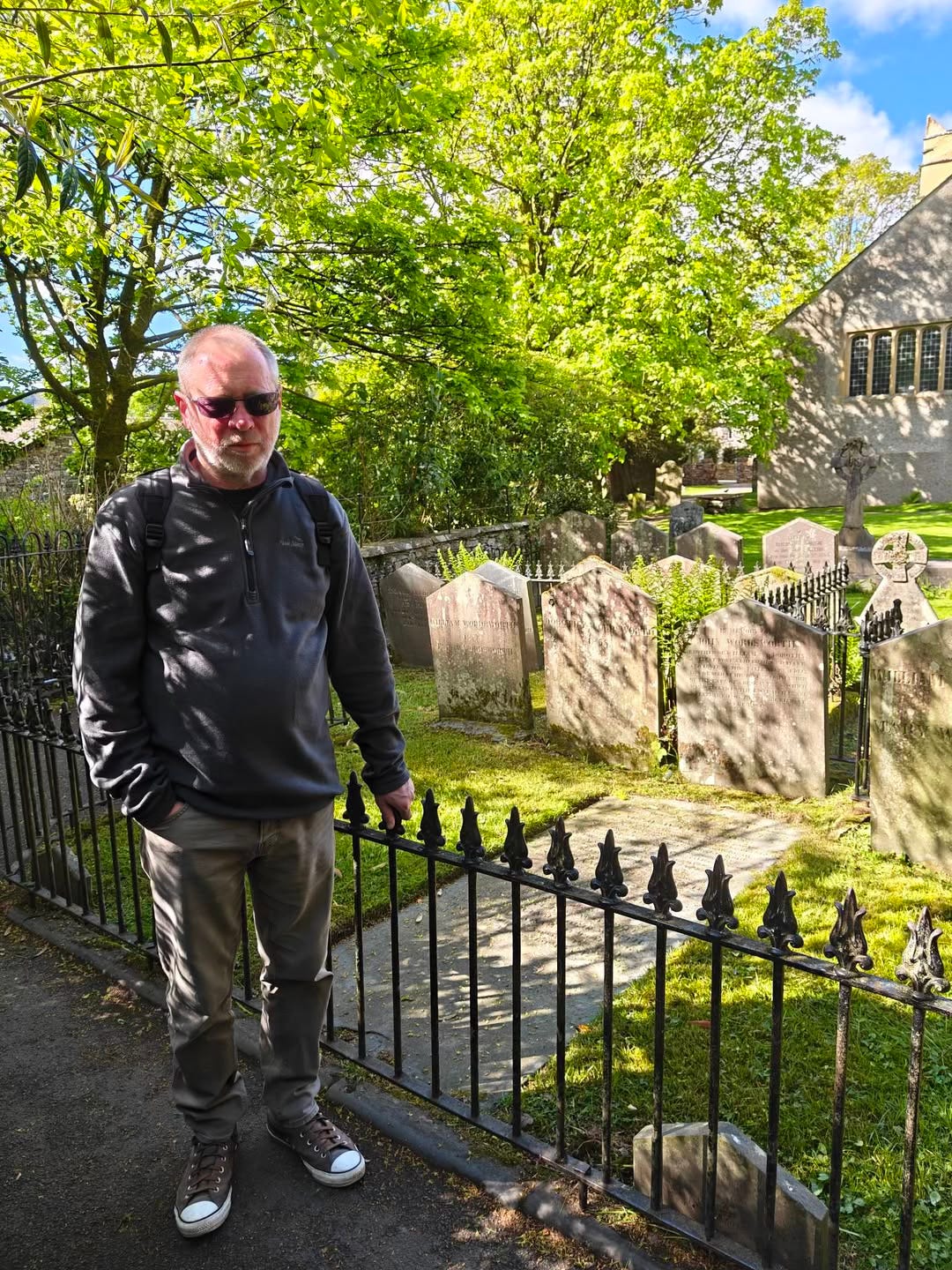
I’ve just returned from a short holiday in Grasmere in the Lake District. This small village is best known for being the home of William Wordsworth for several years at the beginning of the nineteenth century, and the tourism industry is understandably keen to promote this fact. There is a Daffodil Hotel, a daffodil garden and a daffodil trail, all confirming that Wordsworth is best known for the poem beginning “I wandered lonely as a cloud”. This image of Wordsworth as a fey, flower-wielding precursor to Morrissey is firmly fixed in the public imagination which is a shame as ‘Daffodils’ is easily one of his least interesting poems.
The Wordsworth Trust looks after Dove Cottage and the Wordsworth Grasmere Museum and they do a very good job of rectifying Wordsworth’s image. On their website they state:
The stereotypical image of Wordsworth, wandering ‘lonely as a cloud’, uplifted by the daffodils along the shores of Ullswater, or as the elderly Victorian sage of the iconic portraits, is only one side of the famous poet. At Dove Cottage, visitors can discover the story of the young radical who celebrated the French Revolution and travelled around Europe; the poet engaged in politics and society, who believed that love of nature led to love of mankind; the compassionate family man writing about the deepest of human emotions, exploring the importance of self-awareness and focused attention – in other words, mindfulness.
I was really pleased to see in the museum that Wordsworth’s radicalism was not played down. One of the information panels points out that whilst living in Bristol, Wordsworth and Coleridge were monitored by a Home Office agent as their notoriety had led to a belief that they were mapping the coastline to aid a French invasion. Wordsworth was a supporter of the French Revolution and wrote an unpublished polemical pamphlet justifying the necessity of political violence in pursuit of liberty. The handwritten work is on display in the museum and the information panel points out that if it had been published Wordsworth would probably have been arrested for treason. I found this to have poignant contemporary resonance. The Irish writer Sally Rooney has been forthright in her support for Palestine Action and donates some of her royalties to the group. This means that she will be arrested under terrorism legislation if she enters the UK, and even that any new works may be banned in the UK and existing works may have to be withdrawn from sale. Despite the boring accusations of ‘woke media’ there are precious few artists willing to put themselves on the line to this extent and I have huge admiration for Rooney’s integrity.
Wordsworth’s pamphlet ‘A Letter to the Bishop of Landaff’ is surprisingly hard to track down considering the fame of the author. Perhaps its message is still too difficult to digest? In answering an argument against political bloodshed, Wordsworth states:
…the obstinacy and perversion of man is such that she [Liberty] is too often obliged to borrow the very arms of Despotism to overthrow him, and, in order to reign in peace, must establish herself by violence. She deplores such stern necessity, but the safety of the people, her supreme law, is her consolation. This apparent contradiction between the principles of liberty and the march of revolutions; this spirit of jealousy, of severity, of disquietude, of vexation, indispensable from a state of war between the oppressors and oppressed, must of necessity confuse the ideas of morality, and contract the benign exertion of the best affections of the human heart. Political virtues are developed at the expense of moral ones; and the sweet emotions of compassion, evidently dangerous when traitors are to be punished, are too often altogether smothered. But is this a sufficient reason to reprobate a convulsion from which is to spring a fairer order of things?
Wordsworth mellowed into more of a conservative figure with age, partly due to his disillusionment with the course the Revolution took. But this youthful radicalism is important to keep in mind behind the twee trappings of ‘beloved national treasure’™, particularly as we are currently in the midst of a conservative backlash across the West. I suspect that it is more difficult to make a case in favour of political violence today than it was two centuries ago and it is important to remain aware of the shifting ideological constellation that gives context to moral issues. Wordsworth was constrained by the laws of the time from openly expressing his support for bloodshed. Sally Rooney (along with Kneecap and Bob Vylan) are similarly constrained from openly expressing their opposition to bloodshed. Whatever your opinion on the ethics of political violence it is surely instructive to reflect on the increasingly reactionary nature of the background assumptions by which we live.
Not seen that Llandaff quote before – excellent. (I've written elsewhere about 'Daffodils' owing rather a lot to his sister anyway https://www.gethistories.com/p/daffodils-1802)