
Notes From Psychick Albion
Small Prophets

Here’s my article, ‘Small Prophets: Anti-capitalist Magic’, from the latest issue of Undefined Boundary. You can buy the issue here:
Mackenzie Crook’s latest comedy series, Small Prophets, promised to be a worthy heir to his earlier successful series Detectorists. Detectorists often dipped into gently mythic themes, such as thieving magpies and the curse of gold. The Christmas special (2015) leaned more heavily into ghost story tropes with a mysterious figure showing up in the background of a photograph that instantly self combusts, all suggesting that Crook might be an MR James aficionado. With Small Prophets, the theme is more overtly magical - specifically alchemical - yet, as with Detectorists, it is still firmly rooted in a very recognisable contemporary Britain.
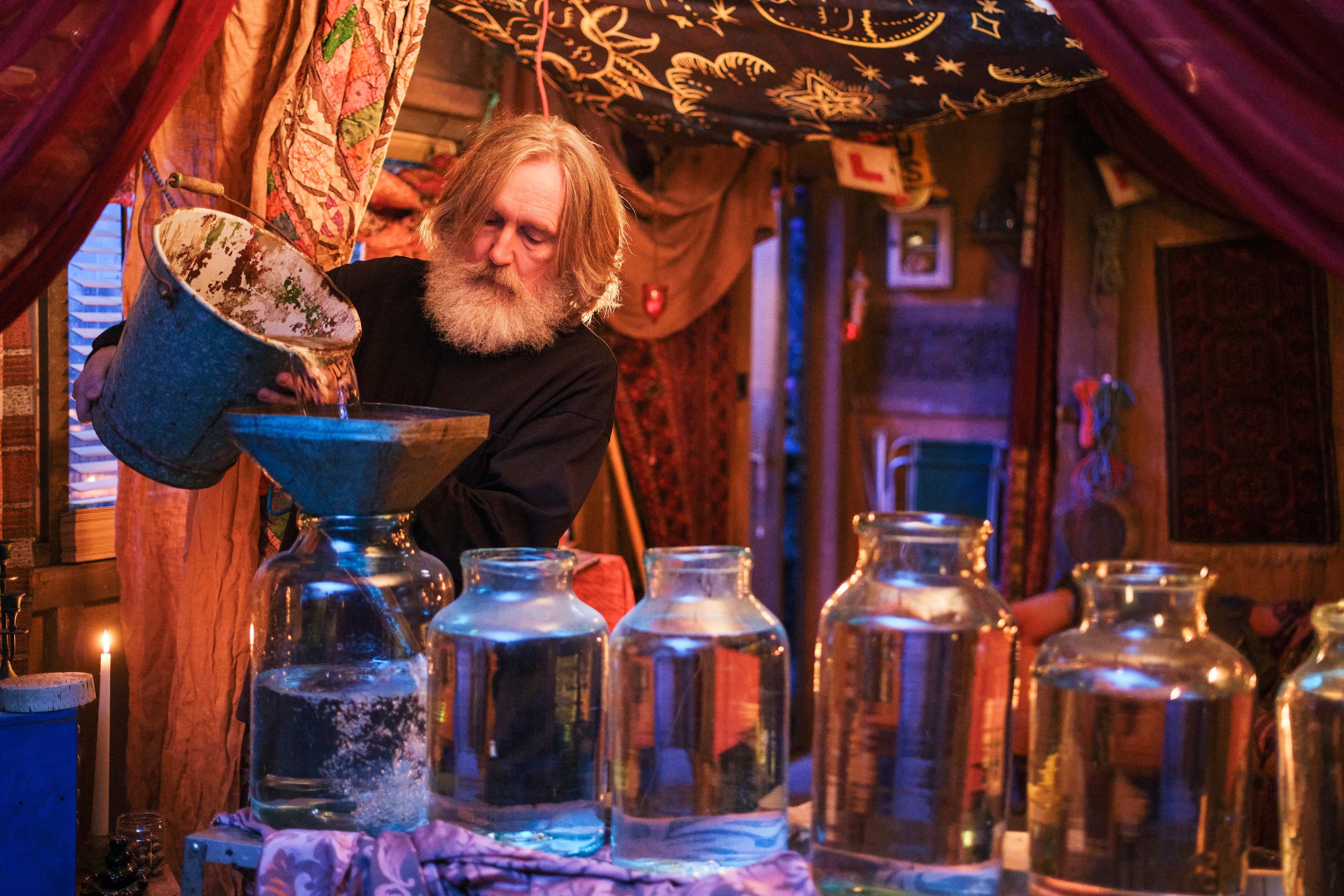
Small Prophets follows the plight of Michael Sleep (played with perfection by Pearce Quigley) who has apparently been stuck in a mournful rut since his partner, Clea, disappeared almost seven years previously. We learn that Clea walked out on Christmas Eve and that her car was later found abandoned on the Severn Bridge, clearly implying that she had committed suicide. The loss of Clea is the emotional bedrock on which the entire series sits. Michael still lives in the house he shared with Clea, a house that is now filled with her possessions piled up in boxes, and which is surrounded by gardens displaying approximately seven years of negligence. He works in a large DIY store in a job that he hates and regularly visits his elderly father in a care home. It is during one of these visits that his father explains to Michael that during his armed service in Egypt he had met an alchemist who shared with him instructions for creating homunculi, small humanoid beings who are able to prophesy the future. He suggests that Michael should grow homunculi himself to discover the truth about what happened to Clea, and whether she will ever return. With the help of his younger work colleague, Kacey, Michael grows three homunculi in his shed and ultimately learns that Clea is still alive, that she still loves him, but that she will not be returning home.
The most original element of the series is in the depiction of a serious act of suburban alchemy, something that is treated with neither melodrama nor ridicule. Crook has spoken about the seed of the idea for the series coming to him when he read a book about the sixteenth century alchemist Paracelsus who gave instructions for growing homunculi in his book De Nartura Rerum. It’s interesting to read Paracelsus’ instructions to see how closely his method is followed in Small Prophets.
“Let the semen of a man putrefy by itself in a sealed cucurbite with the highest putrefaction of the venter equinus for forty days, or until it begins at last to live, move, and be agitated, which can easily be seen. After this time it will be in some degree like a human being, but, nevertheless, transparent and without body. If now, after this, it be every day nourished and fed cautiously and prudently with the arcanum of human blood, and kept for forty weeks in the perpetual and equal heat of a venter equinus, it becomes, thenceforth, a true and living infant, having all the members of a child that is born from a woman, but much smaller. This we call a homunculus; and it should be afterwards educated with the greatest care and zeal, until it grows up and begins to display intelligence.”
The parts of this that Crook retains for Small Prophets are the jar (cucurbite) that the homunculus grows in; the horse manure (venter equinus) that promotes growth; feeding the homunculus; and attending to the intelligence of the homunculus. Rather than following Paracelsus’ instruction to use semen and “arcanum of human blood” (menstrual blood), Crook chose to substitute various symbolic objects (coin, gold ring, etc.), a decision that is understandable in the context of a BBC sitcom. Nonetheless, it’s notable how seriously the whole affair of growing the homunculi is taken, and how much, in its essential characteristics, it sticks to the instructions of a sixteenth century alchemist. The homunculi are certainly no MacGuffin, instead they embody a sense of magical possibility that can be found in the midst of even a sad and lonely life. The numbing imperatives of a minimum wage job may be unavoidable but the magic of DIY alchemy is something graspable by anyone.
Michael is clearly overdue some magic. We infer that his life has become repetitive and rote since losing Clea, divided between the boredom and pettiness of work, the sadness of his father’s life in residential care, and the loneliness of a house that is no longer a home. He has preserved a room that he was preparing as a surprise for Clea. Using a photograph of Clea and her brother celebrating a very 1970s Christmas, Michael has attempted to replicate the scene in his living room, complete with an Action Man helicopter, a Girl’s World hairdressing kit, and a tinsel-decked artificial tree. He has put all of this effort into recreating the scene from the photo as a surprise for Clea but, since her disappearance, he has continued to add to the detail and still keeps the room locked. It’s sadly reminiscent of some parents who lose children and keep their bedrooms exactly as they were in order to symbolically keep alive the hope that they might one day return. It’s a type of mourning which is also a refusal to mourn, a refusal to allow the world to continue to turn because doing so will make real a loss that cannot be tolerated.
Michael’s ongoing sense of grief causes him to refuse to engage with the world but this refusal is very selective. He is utterly uninterested in the world of work (a luxury he can afford, no doubt, due to living in Clea’s brother’s house and so having no housing costs) and he treats his boss with contempt. Yet his interactions with his father and with Hilary at his father’s care home are gentle and filled with care and warmth. In fact, Michael only ever shows contempt, in the form of his mischievous sense of humour, to men. His neighbours, Olive and Bev, are both treated very respectfully; it is only Clive whom he has no time for. And in the DIY store he is only seen pranking male customers. When a female customer asks him for a ‘tit box’, something crying out for a sarcastic response, he instead goes out of his way to help her and actually builds a nest box for her. No doubt, this selective behaviour on Michael’s part is instinctive and is informed by his mythologising of Clea, and by implication the feminine principle, in her absence. It suggests something gendered at the heart of his grief, something that has become amplified and imbalanced in the years since Clea disappeared. It also suggests that Michael has already been engaging with a different sort of alchemy, seeking to integrate with his anima in a Jungian sense.
In this context of turning his face away from the world, the project of growing the homunculi in his shed gives him an opportunity to relate to these creatures in a very controlled way which has nothing to do with his innate sense of how to relate to people. It is a way of “finding answers” rather than coming to terms with grief; it helps to keep emotion at arm’s length. This formality can be seen in the modes of address that Michael and Kacey must adopt when addressing the homunculi: “Your Majesty”, “Ma’am”. Michael even curtseys as he is addressing them before going to work in episode 3. Interestingly, just after this scene of formal deference to the homunculi, Michael and Kacey are shown chatting in the DIY store. Kacey spots a TV newsreader browsing at the end of the aisle and runs over to assist her in a highly servile manner which seems to mimic Michael’s deference toward the homunculi. Perhaps the only difference is that Kacey adopts this tone naturally whilst Michael does so awkwardly. Kacey’s respect for the newsreader though is shown to be based on nothing more than the glamour of celebrity, the distance between us and them: “It was like looking through a window into another life”. Like looking through a glass jar at a homunculus, perhaps. Or, more likely, like a homunculus looking out through their glass prison at us.

Michael’s father says of the homunculi that they “exist in a different realm”; as do the mythical class of celebrities on television, even when they are scraping the barrel. It all signals a difficulty of social relationships, a difficulty that is based on distances and differences between different classes of people (and beings). There is no coherence to the way in which all of this is presented; to be fair, Mackenzie Crook is creating a sitcom rather than a Brechtian form of instruction, after all. But, as he demonstrated in Detectorists, he is attentive enough to the economic reality of living in contemporary Britain that within the incoherence is a very recognisable portrait of the uncertainty and precarity that many people are forced to confront on a daily basis. Compared to Kacey, Michael is lucky. He doesn’t care if he loses his job, because he doesn’t have to pay rent. But both Michael and Kacey are structurally below the newsreader who has her own driver. They are also formally below Gordon, their boss, but neither of them respect that distinction because they have no investment (in any sense of the word) in their employer’s business. For the workers at Tool Box, employment is simply a necessity for paying the rent. (Michael is an eccentric outlier; he goes to work out of habit, or just to pass the time with unhelpful scoffing).
And the most crucial class distinction at the heart of the drama is that between humans and magical beings. Michael’s father has an old fashioned view of the relationship between a magician and the forces that they invoke. He encourages his son to use the homunculi as a means to an end and to avoid any sort of sentimental empathy for them. They exist to answer our questions, nothing more. The question of their own sense of subjectivity and agency is to be pushed aside. As long as they are kept alive to work for us, that is all that we need to care about. At this point, the parallel with the current economic model of employment becomes unmistakable. When the king escapes from his jar and wounds Michael and Kacey in his attempt to avoid being captured, it is difficult to see in what possible sense we shouldn’t be on his side. I have found it interesting to see that in Facebook groups dedicated to Small Prophets, some people are somewhat disturbed by the behaviour of the king in this episode. Comments have suggested that his actions are out of keeping with the more gentle overall tone of the programme. Other commenters point out that the homunculi have no reason to behave in a friendly way towards Michael; they have been brought into being as nothing more than imprisoned slaves to do his bidding and the reaction of the king to finding a possible escape route was perfectly reasonable. The stop motion used to bring the homunculi to life was deployed very deliberately and it perhaps had the effect of making them appear to belong to the gentle world of Oliver Postgate animations. When the king draws blood the impact is all the greater for this prior impression that has been fostered. It suggests that Crook is aware of the real otherness of these magical beings and was intending to draw us in with our own nostalgic prejudices into believing that these cute little creatures are no more dangerous than clangers, or Bagpuss.
But the homunculi are not pets. For that matter, pets aren’t really pets either. They are wild animals who have been deformed into the attenuated forms that flatter our own vanity, projecting cuteness or aggression, as the ‘owner’ requires. Their natural impulses are suppressed in favour of our own desires. And animals are not food, either. They are processed and commodified as such entirely for our own convenience/arrogance/greed. We choose to suppress awareness of the interior lives of other beings so that we can continue to exploit them, and all of the other beings and materials in the natural world, for our own enrichment. We deliberately bend everything towards our own will and deform it into the image we require. Then, when something bites back, we are outraged.
“Imagine having a job that you actually give a fuck about” says Kacey after her chance meeting with the newsreader. For that generation the world of work is a lottery, an entrepreneurial zero sum game where the winner takes all. Michael’s ideal job, counting seagulls, is merely a pretext for being with Clea again; it has nothing to do with earning a living. Michael seems caught between two distinct types of magic. On the one hand he (comically) wears the robes of the medieval magician, summoning beings into existence in order that they might do his bidding. The Dunelm Faust of suburban Manchester. On the other, he has developed a persona of care and attentiveness which seems intuitively grounded in an attempt to embrace the feminine principle. His search for Clea is ultimately a search for something within himself, for a way of being in the world meaningfully, without having to exist on the back of the exploitation of others. His rudeness to the men he meets (excluding his father) is a way of coping with the world, as is his creation of homunculi. Demand answers, demand meaning, and if they are not forthcoming, take the piss. But he also dreams of his seagull Arcadia with Clea. He sits, trancelike, covered in bird shit but not minding at all. He is a part of the ecosystem; he has married his anima and sits enthroned on his nest.
Paracelsus notes that the creation of homunculi is a way of creating life “without the female body and the natural womb,” and this is very much what Michael is doing. It is a magical form of creation that bypasses natural reproduction. Michael sits in a nest with an egg; then a broken egg. Were they unable to have children? Did they lose a child? Michael’s project of raising homunculi becomes the creation of a sort of substitute family, with Kacey as their mother. To the extent that Kacey becomes drawn into this project it reveals to her a completely different side to life of which she had previously been unaware. The unobtainable glamour of TV celebrities is replaced with the gramarye of ritual magic. This is a step beyond the mundane world of commodity production, a world where the most creative way to spend time is to pretend that the commodities you are employed to sell don’t exist; as though the capitalist spell had already been broken. But beyond this first step there is the fuzzy sense of a more profound change that might be possible. A world where we don’t just rein in the urge to amplify big profits, but where we also rein in the urge to control and exploit small prophets.
A really perceptive and enlightening article, thank you very much.