
Notes From Psychick Albion
Albion's Eco-eerie

I thought I would share an extract from Phil Smith’s excellent book Albion’s Eco-eerie, published in 2024 by Temporal Boundary Press. This chapter is about an episode of the Gerry Anderson TV series Fireball XL5 and is a good example of the analysis applied throughout the book.

‘Plant Man From Space’: Fireball XL5, series 1 episode 4 (1962)
My six year old neighbour was banned from watching it; an episode with a Tyrannosaurus Rex on a distant planet kept him up all night with bad dreams. I sailed through that particular episode of the children’s puppet sci-fi series Fireball XL5 without lasting side effects. What did for me, at six years of age, and would haunt my imagination for decades (until I could get hold of a DVD of it) was an episode with the plant-human hybrid, The Chlorophon.
The Fireball XL5 series found a profoundly susceptible place in my psyche. It suggested the possibility of imaginary travel out into space. I had no interest in real rockets or technology or the ‘Space Race’, but I was completely taken by the obvious fabrication of Fireball XL5, its absurdly wooden and nylon characters, and its kinky ‘space’ exploration. Not only was there the arboreal chemistry of the astronauts Steve Zodiac and Dr Venus (no hint there then), but at the end of each episode the credits music would explicitly address the linkage of sex and starry cosmos (Venus and Zodiac) and the sensual-imaginary nature (albeit hetero-normative) of the programme’s space travel: “For though I’m not a spaceman . . . I’ll never reach the stars/My heart is still a fireball, a fireball/Every time I stare into your starry eyes”.
The programme was a part of our social lives. I vividly remember our next door neighbours inviting us round one evening. They were having a new carpet fitted and they asked us over so we could dance in stockinged feet on their exposed parquet floor. We twisted away to a ‘45 of the ‘Fireball’ credits music performed by Don Spencer. It was a close connection we had with our neighbours; my mother’s first meeting with their mother, Doris, was when, having just moved in, she knocked on our door to get our mother to help her; she gave birth to her second child a few short minutes later. When my Mum died a few years back, Doris was the last person, other than immediate family, to spend time with my Mum; a circle was closed.
The structure of the ‘Plant Man From Space’ episode that so traumatised my young self is a thing of beauty; the programme makers shape the unfolding of their yarn with such appropriately organic grace. The key event (as far as I was concerned at six years of age) happens inside a greenhouse on a distant ‘jungle’ planet called Hedera, but it all begins on a weird kind of ‘Earth’ in 2062, which consists of a barren wasteland and one enormous hyper-modern crucifix-shaped tower called Space City. Although this brutalist Dubai-style edifice presumably houses a civilian population, the programme concerns itself only with the crews and ground controllers of a fleet of thirty XL spacecraft whose job it is to protect the Earth from extraterrestrial threats; and they come every week. The cosmos of Fireball XL5 is a paranoid one; their galaxy is never quiet.
‘Plant Man From Space’ begins with the usual descending chords of the opening titles music, oddly melancholic and portentous for a kids’ adventure series. After a sequence in which the spacecraft Fireball XL5 appears first as a huge beast of a ship, glowing like a mountain in the golden hour, and then as a bit of Airfix kit dangling on a string, a creepy wavering electronica starts up and the camera zooms in on a distant planet, Hedera, cutting to an aerial view of a part of the surface where a few greenhouses are the sole intrusion in the planet-encompassing foliage.
We then cut to a panning shot inside one of the greenhouses, a classic horror movie shot moving between two lines of plants, filmed from low down, with the obvious threat of something leaping out from either side or appearing suddenly at the end of the rows; but before we even get there the camera violently swings to one side and reveals The Chlorophon at a lab bench; it is a weird hybrid of leaves and just about recognisable humanoid bilateral symmetry; berries for finger nails, a huge petal for a quiff and three flashing compound ‘eyes’. This monstrosity confides to the camera its plot: “just one of these capsules [of organic plant matter] will immobilise the whole system, and when Space City is immobilized, the Earth is ours . . .”
Quite the posthuman project, then. Which the Chlorophon emphasises by tipping over a scale model of Space City. Cut to the ‘real’ Space City, which is, of course, a model . . . do they intend these ironies? Who cares! ‘They’ are no longer in control of this narrative; the plants are taking over, the Earth is theirs and their allies! One such ally is Dr Roots, a natural historian, who drops a “radioactive retardant capsule” into Space City’s nuclear reactor. Venus – a French scientist, birth name Lily Lumière (a descendent of the Brothers, perhaps?) and orphan of the European Atomic War of 2028 (yikes!) – explains, apropos of nothing, that Dr Roots has been away from Earth for ten years, which presumably explains his going herbaceous.
While Earth’s defences are out of action due to the nuclear reactor shutdown, a missile arrives from space, but does not explode. However, a door in the capsule opens that night and next morning invasive ivy is all over the Earth, even in Venus’s bedroom, overwhelming Space City. Dr Roots excitedly identifies the ivy as coming from Hedera where “plant life dominates every other form of life”. He lures the crew of XL5 to Hedera with the promise of “the hormones that will destroy” the ivy. But there he introduces the crew to the Chlorophon, revealing his betrayal and declaring that “plants . . . will take over the universe so that it is one wild and beautiful garden!” Unfortunately Roots is just one more husbandry merchant, having created the plant-human hybrid to be “the master of the plant world . . . all my work, my work!” He explains how he and the Chlorophon intend to inject Venus, Steve Zodiac and space technician Professor Matt Matic with a “homoclorophyll formula” that will turn them into plant hybrids like The Chlorophon.
It was around about now that, in 1962, I became stricken with a weird kind of fear that then reached unparalleled heights at the sight of the advancing Chlorophon, armed with a hypodermic syringe full of homoclorophyll; despite the monochrome I could see, I could feel, that alien greenness about to enter into my bloodstream through the painful needle. Unfortunately Dr Roots had not accounted for Robert the Robot, XL5’s transparent synthetic chime whistle-headed android, impervious to needles; it beat the Chlorophon to death. An overhead shot of the hypermodern translucent machine looming over the corpse of the pithy human-plant hybrid just about sums up where we are right now . . .
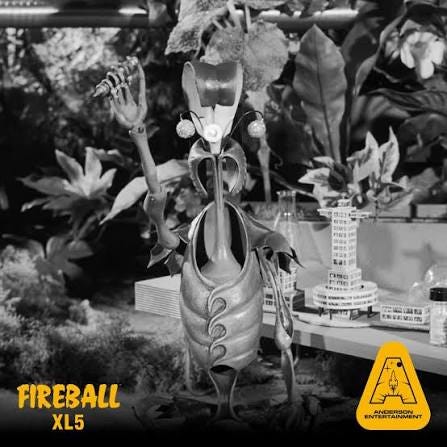
The episode is almost at an end; but first the heroes raid the laboratory of the Chlorophon, take the hormones and inject them into the ivy that has engulfed XL5; as Steve Zodiac inserts the spike into the stem, a black ‘blood’ oozes out (the monochrome convention for human ‘claret’). The suggestion (intended or otherwise) being that the human was already in the plant, just as the plant always wanted to be in the human. Of course at the time, six years old, I was not able to identify what the weird feeling was that I was getting, but six or seven years later I began to realise that something was going on; there were these desires I was subject to that were clearly being manipulated by extra-planetary forces and were wholly incompatible with the mores on offer in the classrooms, churches and chapels on Earth.
At the time, the heteronormative chisel-jawed Steve Zodiac and the soft curvy Dr Venus (and their ilk) were pretty much the only erotic models available. Then a man fell to earth, David Bowie (Jareth, The Goblin King of Labyrinth [1986]), and the parameters of everything changed.
The final credits of ‘Plant Man From Space’, as with all Fireball XL5 episodes, combine Don Spencer’s singing about astral romance with visuals of ‘dead’ planets, their grey surfaces pitted with meteor craters, the (mostly) emptiness of space beyond. Combining abject dread-Pan-ic, the vastness of space and a posthuman erotic promise of queer romance with abstracted, herbal and gritty things to come, ‘Plant Man From Space’, decades ahead of its time, stages our contemporary cyborg alternatives; a reinforced plastic invulnerable machine, free of feeling, or an oozy, creeping thing open to wounding by syringes, wild and beautiful, one bloom in a posthuman garden. Make your choice . . . or make your hybrid . . .