
Notes From Psychick Albion
30th April 2026

I’ve been writing the Temporal Boundary Newsletter for two and a half years on Substack and it was previously sent out via a newsletter app for some time before that. For a while now, I have been conscious of the fact that I am juggling with a need to hold together some disparate imperatives: to keep the newsletter regular (ideally weekly); to communicate updates about the Temporal Boundary Press store and news about forthcoming projects; and to include engaging content about other things relevant to the subject of Psychick Albion. I’m increasingly finding that the need to keep all of these imperatives in mind when composing the newsletter is leading to all three becoming compromised. Sometimes I feel a need to send out the newsletter even when I have little to update, because I want it to be kept as regular as possible. Sometimes, I want to write about a particular topic but have to append it to the end of a newsletter where it might easily be missed. I think that if I’m feeling this way then you the reader will probably also be sensing it and I don’t want you to feel that these communications are becoming stale.
So, I have decided to experiment with splitting the newsletter into two. The existing newsletter (Temporal Boundary Newsletter) will continue as before but may become less regular as I want to make sure it contains genuine updates rather than repetitions of what has been posted before. And, to keep communication more frequent, I will be supplementing it with a new series of posts: ‘Notes From Psychick Albion’. This will be a mixture of thoughts and observations that would be too long for a social media post, with news about kindred projects that you might be interested in but which Temporal Boundary Press is not involved with. You will find the first instalment by scrolling down below. I hope that by separating out these two elements, both will become stronger. Please, as always, let me know what you think.
Popular Transcendence
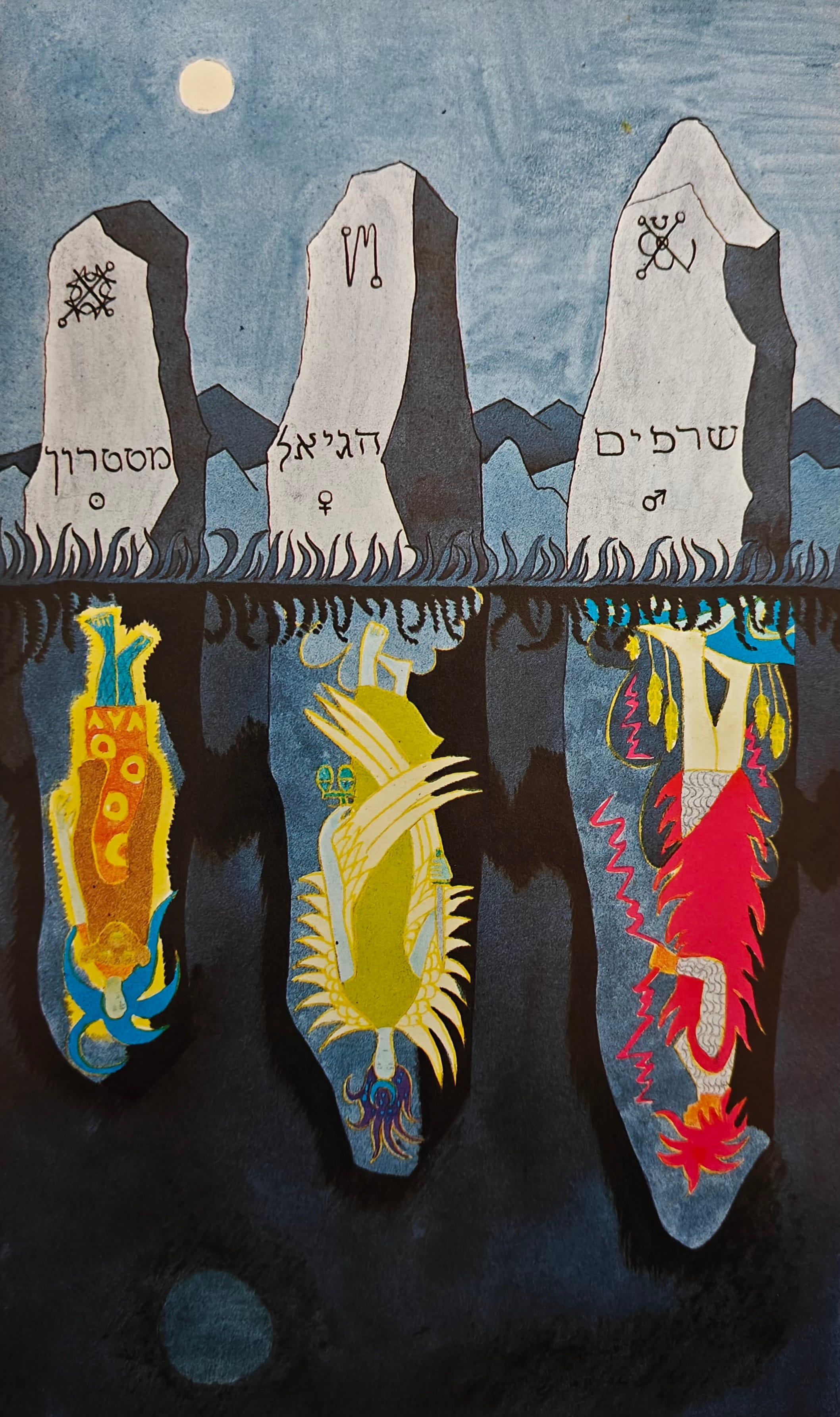
As a culture we seem to feel very comfortable with the idea that music used to have a religious function but we treat modern music as almost entirely secular. We know that Bach was typically composing his music around the liturgical calendar and that he regarded this work as being religious in character, and it is easy to listen to his music and experience a form of transcendent uplift that he would have fully intended. But if we think of religious music today, perhaps we think of hymns or evangelical rock, neither of which seem particularly suited to communicating a sense of transcendence outside of the already converted. Yet we are each of us aware that contemporary music can inspire some sort of transcendent uplift, whether through live performance, vocal timbre, melody, or many other means. It’s just that we think of this as being somehow to do with the power of art rather than religion, and it is certainly true that with the decline of Christianity over the past couple of centuries, meaning and spirit have migrated to other places in culture.
I was prompted to consider this yesterday afternoon when I caught part of a radio interview with Brett Anderson (from Suede) and James Dean Bradfield (from Manic Street Preachers). I’m not a particular fan of either band but they are evidently both intelligent and thoughtful frontmen. At one point, they were asked about the pressure to include their old hits in their sets and how they felt about doing so. Bradfield spoke about the power of playing those songs in a field and prompting a large crowd to experience a feeling of transcendence to another place and time. I realised then that the word ‘transcendence’ can have quite antithetical meanings; or rather that it can be deployed in opposite ways.
There is undoubtedly a great deal of solace to be found in listening to music from our youths, and doing so certainly has that Proustian quality of putting us back into an earlier time when it felt that life had more possibility and potential. In this sense it is transcendent because it takes us out of our present material situation and transports us to a different time when life’s coordinates were mapped differently. I think that for many people this is almost the point of popular music: to take us back to our youth, or at least to soundtrack particular phases of life. But this is to deploy the experience of transcendence for nostalgic purposes and to treat it as though it is a way of escaping from the Real (however temporarily). Similarly, religion can be used to escape from the Real; we are all familiar with the phrase “religion is the opium of the people”. But now that religion has declined in importance, the transcendent function has been displaced elsewhere, and the palliative qualities of transcendence have come to attach themselves to the new forms of artistic creation. Perhaps the real point of distinction is only this: that whereas religion pacified the pain of the present by promising comfort in the afterlife, pop music pacifies the present by keeping alive memories of the past. In both cases, there is an escape from the real, material conditions of the present that does nothing to improve or enliven those conditions but perhaps helps to quieten some of the anxieties stemming from them.
Perhaps you might think that this is not describing real transcendence; that the idea of using a fuzzy feeling of spirituality to escape from the present moment is a form of distraction rather than transcendence proper. The meaning of the word ‘transcendence’ is literally ‘to climb beyond’ from trans- (beyond) and scandere (to climb). It suggests a movement away from the mundane conditions of the present to somewhere (or somewhen) else, but it does not suggest where or when this may be. In this sense it is neutral, signifying some sort of beyond but not specifying its character. The point is that the experience of listening to a pop song that made your teenage self cry is not an inauthentic experience that stands in as a substitute for an authentic religious experience. The subjective experience is similar in both cases but the wider cultural context will insist that they should be understood differently. Either can be profound or tawdry depending on the context and the effects of the experience.
Nostalgia and religious experience are both, therefore, relevant to the subject of Psychick Albion but neither are really sufficient. The most radical use of transcendence is that which enables new potentialities to emerge from the conditions of the present, and which reveals new ways of being in the world. This is the fundamentally creative use of transcendence that seeks to shape the world as it is into new forms of what can be. It does not give a sense of consolation by looking back to a lost past, nor forward to a life after this one, but rather insists on a rebirth in a truly immanent sense, changing the world in unexpected ways. In this sense, it shares a kinship with one of the more important aims of political thinking. Mark Fisher expressed it in this way:
“Emancipatory politics must always destroy the appearance of a ‘natural order’, must reveal what is presented as necessary and inevitable to be a mere contingency, just as it must make what was previously deemed to be impossible seem attainable.”
This is the sense in which I endeavour to understand transcendence. Rather than using transcendence as a way of consoling oneself to the difficulty of life as it is, I prefer the more radical position of using transcendence to alert us to previously hidden possibilities and shocking us out of a zombified reconciliation with an enervated ‘realism’. The insistence on a ‘natural order’ is an ideological position in both a political and a metaphysical sense. The conservative mindset hopes to use transcendence to quieten us down by appealing to the past or the future as places where consolation can be found. Instead of this, we should be very noisy in disrupting the existing order and rendering it unnatural. From such mutations, creative evolution will emerge.